
Syringomyelia: Treating a Fluid-Filled Cyst in the Spinal Cord
Syringomyelia often develops quietly, with symptoms like hand numbness or burning pain that come on slowly over years. Finding and treating the underlying cause can stop it from progressing and often improves symptoms.
What Is Syringomyelia?
Syringomyelia is a condition in which a fluid-filled cavity, called a syrinx, forms inside the spinal cord. Over time, the syrinx can expand and lengthen, damaging the nerve fibers around it. It most often occurs in the neck (cervical spine) and upper back.
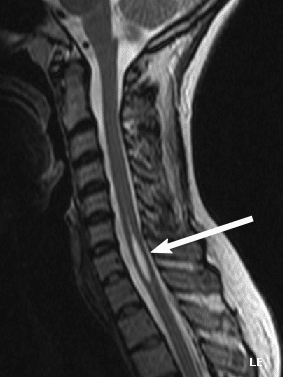
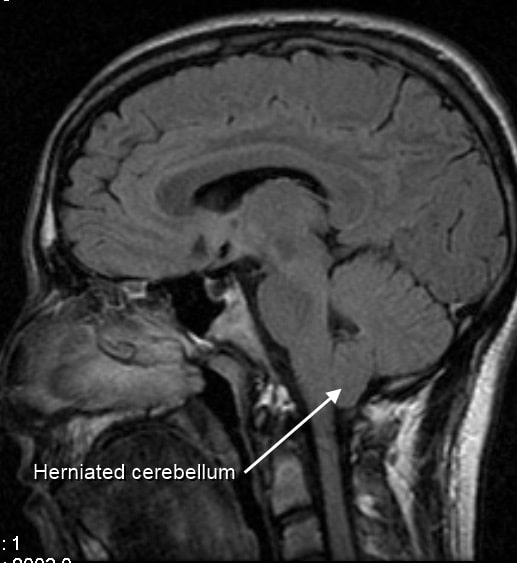
A syrinx usually forms because the normal flow of cerebrospinal fluid (CSF) around the spinal cord is blocked. The most common cause is a Chiari malformation. Other causes include spinal cord injury, scarring, tumors and tethered spinal cord.
Symptoms
Common symptoms
- Neck, shoulder or upper back pain
- Burning or aching pain in the arms or hands
- Numbness, especially loss of pain and temperature sensation in a “cape” pattern across the shoulders and arms
- Weakness or wasting of the hand muscles
- Stiffness or weakness in the legs
Symptoms patients often ignore
- Painless burns or cuts on the hands because temperature or pain isn’t felt
- Gradually weakening grip
- Headaches triggered by coughing or straining, which can point to Chiari
- A new or worsening curve of the spine (scoliosis)
- Bladder or bowel changes
When it’s an emergency: Rapidly worsening weakness, trouble breathing or swallowing, or bladder or bowel changes need emergency care. Call 911 or go to the nearest emergency room.
Causes and Risk Factors
- Chiari malformation: the most common cause
- Spinal cord injury: a syrinx can form months or years after an injury
- Arachnoiditis or scarring: after infection, bleeding or surgery
- Spinal cord tumors
- Tethered spinal cord
How We Diagnose Syringomyelia
- Neurological exam: strength, reflexes and sensation, including temperature and pain
- MRI of the brain and spine: shows the syrinx and its cause, such as Chiari or a tumor
- MRI with contrast: to rule out a tumor
- CSF flow studies: show where fluid flow is blocked
Treatment Options
Observation
A small syrinx that isn’t causing symptoms or growing may be monitored with periodic MRI scans.
When surgery makes sense
Surgery is recommended when a syrinx causes symptoms or is enlarging. The goal is to treat the cause and restore normal CSF flow, which can often correct the problem and keep it from progressing:
- Chiari decompression: when Chiari is the cause, creating more room at the base of the skull often makes the syrinx shrink
- Removing scar tissue or a tumor that is blocking fluid flow
- Tethered cord release when that is the cause
- Syrinx shunting: placing a small tube to drain the syrinx when the cause can’t be corrected directly
Dr. Grunch performs many of these procedures. For complex cases or revision surgery, she refers patients to a specialist at an academic medical center.
Why Choose Dr. Betsy Grunch for Syringomyelia
- Duke-trained: neurosurgical residency and spine research fellowship at Duke University School of Medicine, where she received the Spine Young Investigator Award
- Experience you can count on: in practice since 2013, performing 400 to 600 surgeries a year and more than 5,000 procedures over her career
- Comprehensive neurosurgical care: she treats conditions of the brain, spine and peripheral nerves
- The right treatment for you: board-certified (FAANS, FACS, FCNS), she starts with the least invasive option that will work, and recommends surgery when it can correct the problem
- Clear answers: known online as Ladyspinedoc, she makes sure you understand your imaging and every option in front of you
What to Expect If You Need Surgery
Before surgery
You’ll meet with Dr. Grunch or one of her physician assistants to review your MRI and choose the procedure that addresses the cause. Our team coordinates pre-operative testing.
Procedure day
Surgery typically takes a few hours. Most patients stay in the hospital for several days.
Recovery timeline
- Days 1-4: walking with help; pain control
- Weeks 1-6: rest and gradual activity; no heavy lifting
- Months 3-6: follow-up MRI to confirm the syrinx is shrinking
- Long term: pain and weakness often stabilize or improve; numbness may improve more slowly
Frequently Asked Questions
Is syringomyelia dangerous?
It can be if it grows, because it can permanently damage the spinal cord. Many people do well with monitoring or surgery to treat the cause.
Will the syrinx go away after surgery?
Often it shrinks, especially after Chiari decompression. Even when it doesn’t fully disappear, stopping its growth protects the spinal cord.
Will my symptoms improve?
Pain and weakness often stabilize or improve. Nerve damage that has been present for a long time may not fully recover, which is why timely treatment matters.
Can a syrinx come back?
It can, so follow-up MRI scans are recommended.
Why can’t I feel hot water on my hands?
The nerve fibers that carry pain and temperature cross right in the center of the spinal cord, where a syrinx forms. That’s why loss of temperature sensation is a classic sign.
Take the First Step Toward Relief
Whether you need a diagnosis, a treatment plan or a second opinion, Dr. Grunch and the Southern Neurosurgery team are here to help.
Call 470-293-9800 to schedule an appointment or contact us online.
Have a question first? Ask our virtual assistant anything, 24/7.
We see patients across metro Atlanta and North Georgia at our offices in Gainesville, Sandy Springs and South Atlanta (Riverdale). Find the office nearest you.
This page is for educational purposes only and is not a substitute for medical advice. If you have a sudden severe headache, a seizure, new weakness or numbness, confusion, or trouble speaking or seeing, call 911 or go to the nearest emergency room.