
Freeing the Spinal Cord in Adults
A tethered spinal cord is often thought of as a childhood condition, but it can cause symptoms for the first time in adulthood, sometimes after years of unexplained back pain or bladder changes. For the right patient, tethered cord release can often correct the problem by freeing the spinal cord so it is no longer stretched.
What Is Tethered Cord Release?
Normally, the lower end of the spinal cord hangs freely inside the spinal canal and can move as you bend and stretch. In tethered cord syndrome, the cord is attached to surrounding tissue, so it is stretched with movement. Over time, this stretching can affect the nerves to the legs, bladder and bowels.
In adults, the most common cause is a thickened or fatty filum terminale, the thin band of tissue that anchors the bottom of the spinal cord. Other causes include a fatty mass (lipoma) attached to the cord, spina bifida occulta, and scar tissue after earlier spine surgery.
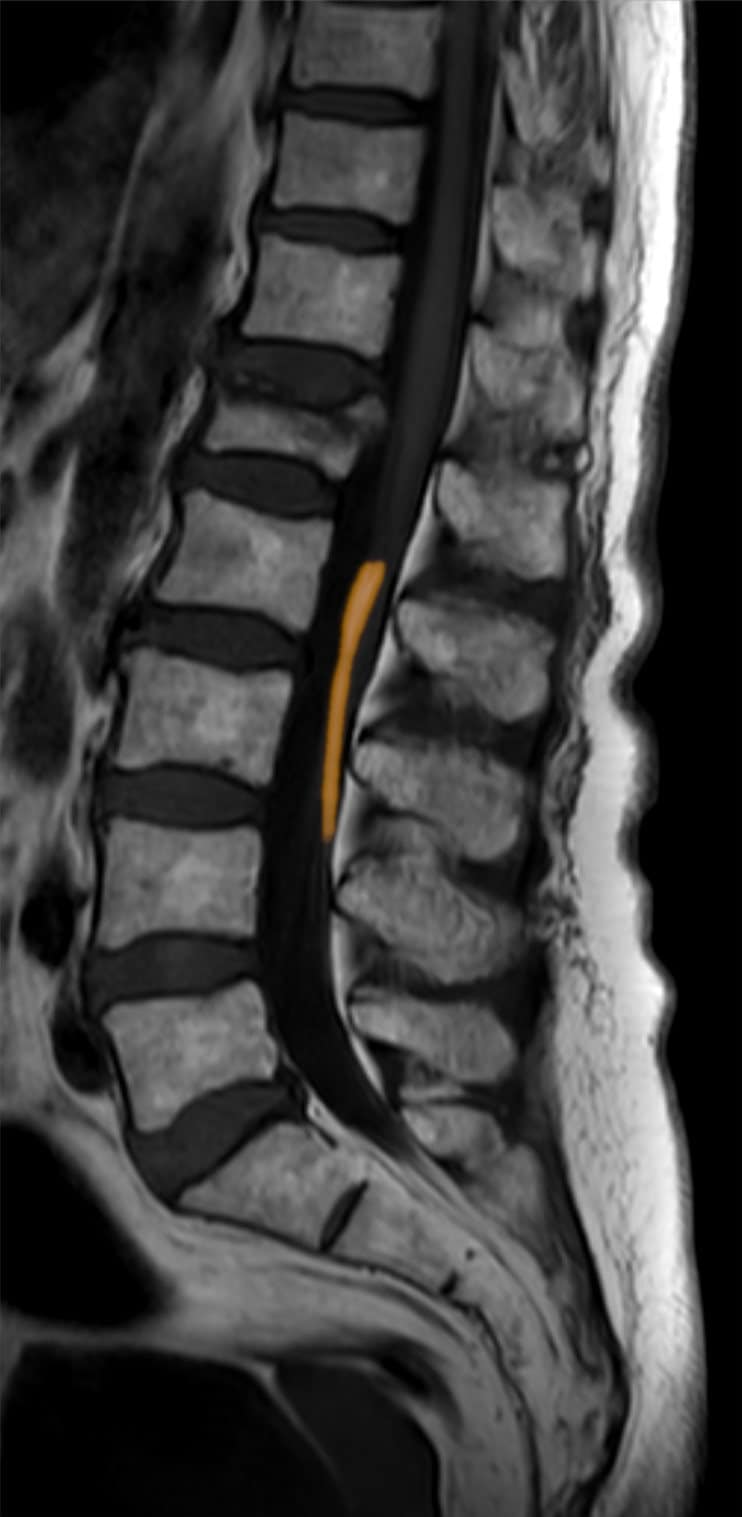
Tethered cord release is surgery to cut or remove the tissue holding the spinal cord down, so the cord can move freely again.
Who Needs Tethered Cord Release?
- Low back pain that spreads to the legs and is worse with bending or exercise
- Leg numbness, weakness or changes in walking
- New bladder or bowel problems, such as urgency, frequent infections or trouble emptying
- Foot changes or worsening scoliosis
- An MRI showing a low-lying spinal cord or a thickened, fatty filum that matches your symptoms
Treatments to Try First
- Observation: a fatty filum or low-lying cord found by chance without symptoms is usually just watched
- Testing: bladder studies (urodynamics) and nerve studies help confirm that symptoms come from the tethered cord
- Physical therapy and pain management: for back pain while the diagnosis is confirmed
When symptoms are progressing, surgery can often correct the problem, ideally before nerve damage becomes permanent.
How Tethered Cord Release Is Done
- Anesthesia and monitoring: You’ll be fully asleep. Nerve monitoring, including of the nerves to the bladder, is used throughout surgery.
- Opening: A small incision is made in the lower back, and a small amount of bone is removed (a laminectomy).
- Releasing the cord: Under the microscope, the dura is opened, the filum terminale is identified with nerve monitoring and cut. A lipoma or scar tissue is carefully removed or released.
- Closing: The dura is closed watertight, and the muscles and skin are closed.
Watch Dr. Grunch explain tethered cord syndrome:
Video: Case Study 146, Tethered Cord Syndrome and Spina Bifida Occulta, explained by Dr. Grunch on her Ladyspinedoc channel (YouTube)
A note on repeat (revision) tethered cord surgery
Some people develop a tethered cord again after an earlier release, as scar tissue forms. Repeat tethered cord surgery is more complex, and Dr. Grunch refers these patients to surgeons who specialize in revision tethered cord surgery so they get the best possible care.
Benefits and Risks
Benefits
- Relieves tension on the spinal cord
- Often improves back and leg pain
- Can stop leg weakness and bladder problems from getting worse, and sometimes improves them
Risks
- A spinal fluid leak from the dura repair
- New or worsened numbness, weakness or bladder problems, which are uncommon and often temporary
- The cord becoming tethered again from scar tissue
- Infection or bleeding
- Risks related to anesthesia
Why Choose Dr. Betsy Grunch for Your Tethered Cord Release
- Duke-trained: Dr. Grunch completed her neurosurgical residency and a spine research fellowship at Duke University School of Medicine, one of the top neurosurgery programs in the country.
- Careful diagnosis: Dr. Grunch matches your MRI with your symptoms and, when needed, bladder and nerve testing, so surgery is recommended only when the tethered cord is truly the cause.
- Nerve monitoring and microsurgery: Spinal cord surgery is done under the operating microscope with continuous nerve monitoring to protect strength, sensation and bladder function.
- Experience you can count on: She has been in practice since 2013 and performs 400 to 600 surgeries a year, more than 5,000 procedures over her career.
- A teacher at heart: As “Ladyspinedoc,” she is known for explaining brain and spine conditions clearly. You’ll leave your visit understanding your imaging and every option in front of you.
What to Expect
Before surgery
You’ll meet with Dr. Grunch or one of her physician assistants to review your CT or MRI, your symptoms and your goals, and to decide together whether tethered cord release is right for you. Our team will coordinate pre-operative testing, review your medications (including blood thinners you may need to pause) and walk you through the day of surgery. You may have bladder testing (urodynamics) before surgery so your bladder function can be compared afterward.
Procedure day
Surgery usually takes two to three hours. You may be asked to lie flat for the first day or two to protect the dura repair. Most patients stay in the hospital for two to four days.
Recovery timeline
- First days: Lying flat, then getting up to walk.
- Two weeks: Stitches or staples are removed.
- Four to six weeks: A follow-up visit. Many people return to desk work around this time.
- Months: Pain often improves first. Bladder and leg symptoms tend to stabilize and may improve gradually.
Caring for yourself at home
- Your incision: If it is closed with skin glue, you may shower the day after surgery; if it has stitches or staples, wait three days. Pat it dry and don’t use ointments or creams. Don’t soak in a bath, hot tub or pool for six weeks. Stitches or staples are usually removed in 10 to 14 days.
- Activity: Walk several times a day. Avoid bending, twisting, straining and lifting more than 10 pounds for about four to six weeks.
- Lying flat: Because the covering of the spinal cord is opened and sewn closed, you may be asked to lie flat for the first day or two to protect the repair.
- Medications: Take pain medication with food, avoid alcohol while taking it and use a daily stool softener so you don’t strain. Don’t restart blood thinners until Dr. Grunch’s team tells you it’s safe.
- Driving: You may drive once you are off narcotic pain medication and can turn and react comfortably.
Call the office at 470-293-9800 if you have a fever over 101°F, redness, swelling or drainage from the incision, clear fluid leaking from the incision, a headache that is worse when you sit or stand, or calf pain or swelling. Call 911 for new weakness or numbness, loss of bladder or bowel control, chest pain or shortness of breath.
Download your patient instructions
Your instructions depend on the type of surgery you have. Our team will give you written instructions before you go home, and you’ll find other patient sheets on our Patient Resources page.
Frequently Asked Questions
Can adults have a tethered cord?
Yes. Some people are born with a tethered cord but don’t develop symptoms until adulthood, sometimes triggered by activity, pregnancy or a fall.
Will my bladder problems get better?
Surgery is most likely to stop bladder problems from getting worse. Improvement is possible, especially when symptoms are recent.
What if I’ve already had tethered cord surgery?
Repeat tethered cord surgery is more complex. Dr. Grunch refers these patients to surgeons who specialize in revision tethered cord surgery.
Does a fatty filum on my MRI mean I need surgery?
Not necessarily. Surgery is considered only when your symptoms match the MRI findings.
How long is recovery?
Most people return to desk work in about four to six weeks and to full activity in about three months.
Take the Next Step
If you’re living with back pain, leg symptoms or bladder changes from a tethered cord, you don’t have to navigate it alone. Whether you need a diagnosis, a treatment plan or a second opinion, Dr. Grunch and the Southern Neurosurgery team are here to help you understand your options.
Call 470-293-9800 to schedule an appointment or contact us online.
Have a question first? Ask our virtual assistant anything, 24/7.
We see patients across metro Atlanta and North Georgia at our offices in Gainesville, Sandy Springs and South Atlanta (Riverdale). Find the office nearest you.
Related pages: Tethered cord syndrome · Syringomyelia · Syrinx surgery · Spinal cord tumor resection
This page is for educational purposes only and is not medical advice. It does not replace individualized care from a licensed physician. If you have sudden weakness, numbness, loss of bladder or bowel control, or a sudden severe headache, call 911 or go to the nearest emergency room.