
Making Room at the Base of the Skull
A Chiari malformation can cause headaches at the back of the head, neck pain, dizziness and numbness that are easy to dismiss for years. When symptoms or a syrinx develop, Chiari decompression can often correct the problem by making more room at the base of the skull and restoring normal spinal fluid flow.
What Is Chiari Decompression?
In a Chiari malformation, the lowest part of the cerebellum, called the tonsils, extends below the skull into the top of the spinal canal. This crowds the brainstem and spinal cord and blocks the normal flow of spinal fluid between the brain and spine.
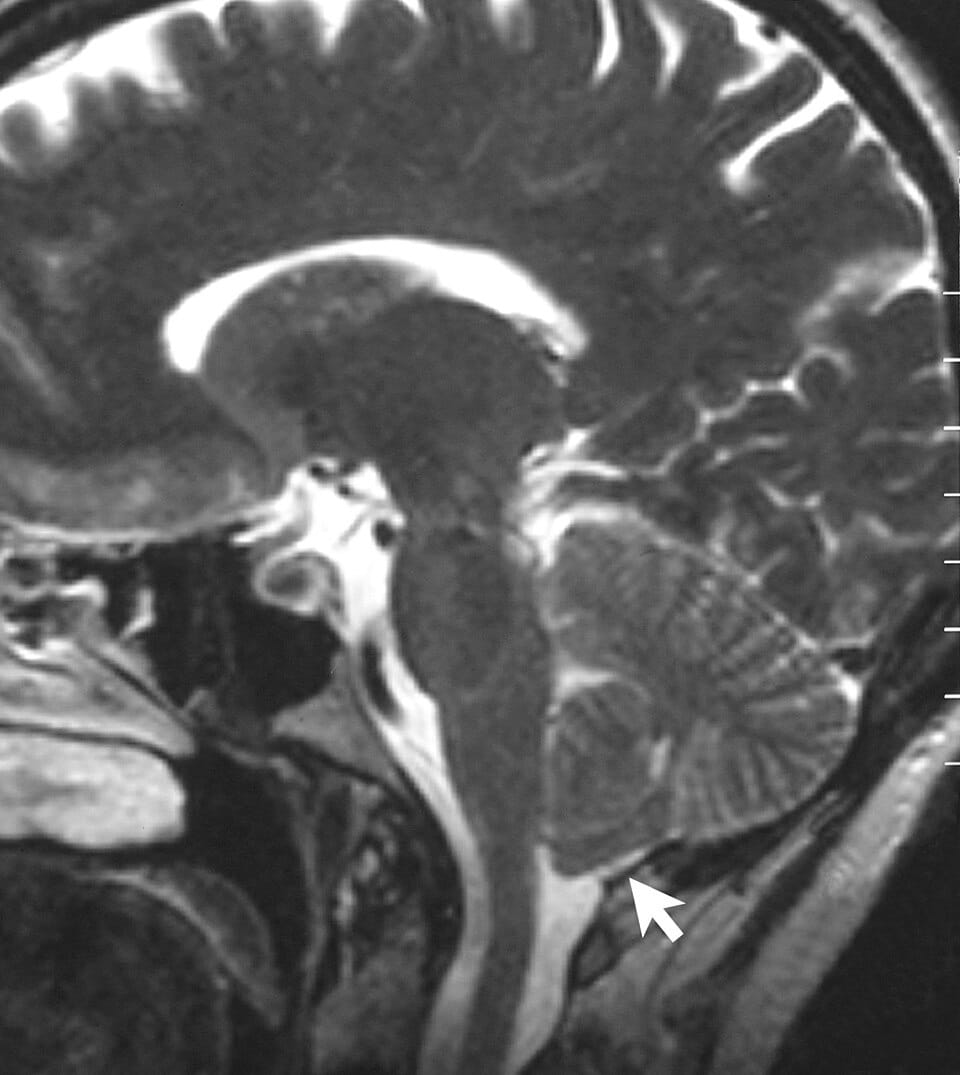
Chiari decompression (posterior fossa decompression) is surgery to create more space. A small piece of bone is removed from the back of the skull, often along with the back of the first vertebra (C1). In many patients, the dura is opened and enlarged with a patch (duraplasty) to give even more room.
Who Needs Chiari Decompression?
- Headaches at the back of the head that are triggered by coughing, sneezing, laughing or straining
- Neck pain, dizziness, balance problems, trouble swallowing or ringing in the ears
- Numbness, tingling or weakness in the arms or hands
- A syrinx in the spinal cord
Many people have a Chiari malformation on an MRI without any symptoms. They usually don’t need surgery.
Treatments to Try First
- Observation: for people without symptoms, or with mild symptoms, with follow-up MRI scans
- Headache treatment: medications and avoiding triggers such as heavy straining
- Physical therapy: for neck pain and posture
- Checking for other causes: such as high spinal fluid pressure or low spinal fluid pressure, which can mimic or worsen Chiari symptoms
How Chiari Decompression Is Done
- Anesthesia and positioning: You’ll be fully asleep, lying face down with your head held still. Nerve monitoring is often used.
- Opening: An incision is made at the back of the head and upper neck.
- Removing bone: A small piece of the skull at the base of the head is removed, along with the back of C1 when needed.
- Duraplasty: When needed, the dura is opened and a patch is sewn in to enlarge the space around the cerebellum and brainstem.
- Closing: The muscles and skin are closed in layers.
Watch Dr. Grunch explain a Chiari malformation type 1:
Video: Case Study 142, Chiari Malformation Type 1, explained by Dr. Grunch on her Ladyspinedoc channel (YouTube)
And a Chiari malformation case:
Video: Case Study 10, Chiari Malformation, presented by Dr. Grunch on her Ladyspinedoc channel (YouTube)
Benefits and Risks
Benefits
- Often relieves headaches triggered by coughing or straining
- Restores spinal fluid flow, which often makes a syrinx shrink
- Can improve or stop the progression of numbness, weakness and balance problems
Risks
- A spinal fluid leak or a fluid collection under the incision
- Headaches or neck pain during recovery
- Meningitis, including a non-infectious inflammation from the dural patch
- Symptoms that don’t improve or that return
- Bleeding, stroke or injury to the brainstem, which are rare
- Risks related to anesthesia
Why Choose Dr. Betsy Grunch for Your Chiari Decompression
- Duke-trained: Dr. Grunch completed her neurosurgical residency and a spine research fellowship at Duke University School of Medicine, one of the top neurosurgery programs in the country.
- Surgery only when it helps: Dr. Grunch carefully matches your symptoms to your MRI, since many people with Chiari on imaging never need surgery.
- Nerve monitoring and microsurgery: Surgery near the brainstem and upper spinal cord is done under the operating microscope, with nerve monitoring to protect strength and sensation.
- Experience you can count on: She has been in practice since 2013 and performs 400 to 600 surgeries a year, more than 5,000 procedures over her career.
- A teacher at heart: As “Ladyspinedoc,” she is known for explaining brain and spine conditions clearly. You’ll leave your visit understanding your imaging and every option in front of you.
What to Expect
Before surgery
You’ll meet with Dr. Grunch or one of her physician assistants to review your CT or MRI, your symptoms and your goals, and to decide together whether Chiari decompression is right for you. Our team will coordinate pre-operative testing, review your medications (including blood thinners you may need to pause) and walk you through the day of surgery. You’ll have an MRI of the brain and spine, and sometimes a flow study, to see how spinal fluid is moving.
Procedure day
Surgery usually takes two to three hours. Most patients stay in the hospital for two to four days.
Recovery timeline
- First days: Neck soreness and headaches are common and are managed with medication.
- Two weeks: Stitches or staples are removed.
- Four to six weeks: A follow-up visit. Many people return to desk work around this time.
- Three months and beyond: Most people return to full activity. A follow-up MRI may be done to check a syrinx.
Caring for yourself at home
- Your incision: You can usually shower after two to three days. Let water run gently over the incision and pat it dry. Don’t scrub, soak in a bath or pool, or use hair dye or harsh hair products until it has fully healed. Staples or stitches are usually removed in 10 to 14 days.
- Activity: Walk every day and rest when you’re tired. Avoid heavy lifting, bending over and straining for about four to six weeks, and avoid contact sports until you are cleared.
- Your neck: Neck stiffness is common. Gentle range-of-motion movements help, but avoid heavy lifting and straining.
- Medications: Take any seizure medication exactly as prescribed and don’t stop it on your own. Don’t take blood thinners, aspirin or anti-inflammatory medications such as ibuprofen until Dr. Grunch’s team tells you it’s safe. Take pain medication with food, avoid alcohol and use a stool softener so you don’t strain.
- Driving: Don’t drive until you are cleared. If you have had a seizure, Georgia law limits driving for a period of time.
- Recovery at home: Fatigue, headaches and trouble concentrating are common for several weeks. Have someone stay with you for the first few days.
Call the office at 470-293-9800 if you have a fever over 101°F, redness, swelling or drainage from the incision, clear fluid leaking from the incision or nose, or calf pain or swelling. Call 911 for a seizure, a sudden severe headache, new confusion or drowsiness, new weakness or numbness, trouble speaking, chest pain or shortness of breath.
Download your patient instructions
Your instructions depend on the type of surgery you have. Our team will give you written instructions before you go home, and you’ll find other patient sheets on our Patient Resources page.
Frequently Asked Questions
Does everyone with a Chiari malformation need surgery?
No. Many people have a Chiari malformation on MRI without symptoms and never need surgery.
Will my headaches go away?
Headaches triggered by coughing, sneezing or straining often improve the most. Other types of headaches may not change.
Will surgery fix my syrinx?
Restoring spinal fluid flow often makes a syrinx shrink over several months.
Is the bone put back?
No. The bone removed at the base of the skull is not replaced. The thick neck muscles protect the area.
How long is recovery?
Most people return to desk work in about four to six weeks and to full activity in about three months.
Take the Next Step
If you’re living with a Chiari malformation, you don’t have to navigate it alone. Whether you need a diagnosis, a treatment plan or a second opinion, Dr. Grunch and the Southern Neurosurgery team are here to help you understand your options.
Call 470-293-9800 to schedule an appointment or contact us online.
Have a question first? Ask our virtual assistant anything, 24/7.
We see patients across metro Atlanta and North Georgia at our offices in Gainesville, Sandy Springs and South Atlanta (Riverdale). Find the office nearest you.
Related pages: Chiari malformation · Syringomyelia · Syrinx surgery · Pseudotumor cerebri · Intracranial hypotension
This page is for educational purposes only and is not medical advice. It does not replace individualized care from a licensed physician. If you have sudden weakness, numbness, loss of bladder or bowel control, or a sudden severe headache, call 911 or go to the nearest emergency room.