
Relief for Chronic Back, Leg and Nerve Pain
Living with chronic pain that hasn’t responded to surgery, injections or medications can be exhausting. A spinal cord stimulator lets you test-drive relief before committing, and for many people it can significantly reduce pain and the need for pain medications.
What Is a Spinal Cord Stimulator?
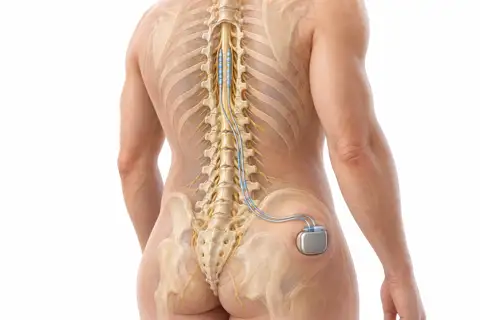
A spinal cord stimulator is a small implanted device that sends mild electrical signals to the spinal cord. These signals change how pain messages travel to the brain, reducing the pain you feel. Many newer systems work without the tingling sensation older devices produced.
The system has two parts:
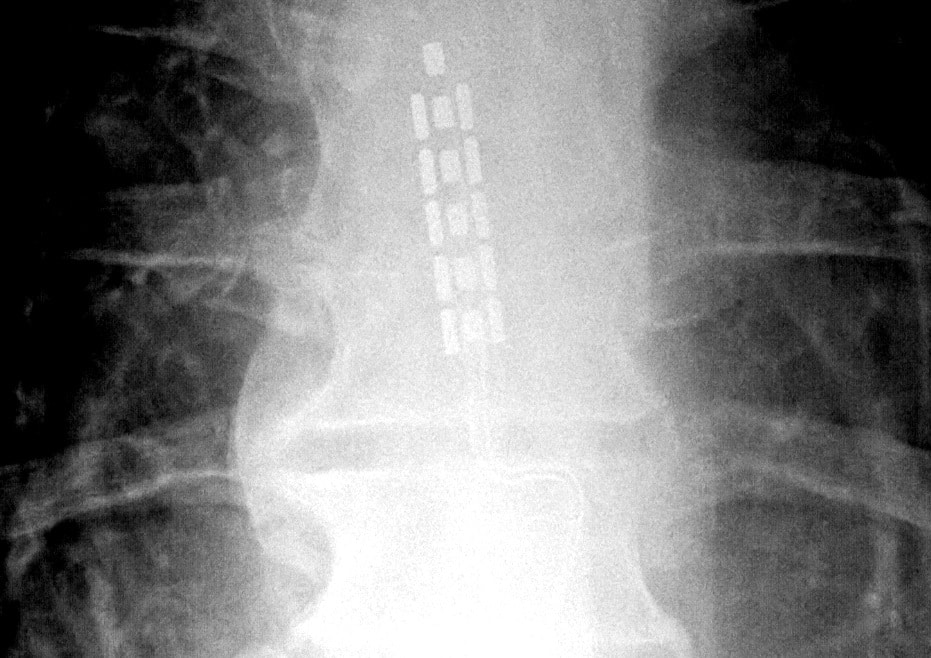
- Leads: thin wires with small contacts, placed in the space just behind the spinal cord
- Battery (generator): a small device placed under the skin of the hip or flank. Many are rechargeable.
You control the stimulator with a handheld remote, and the settings can be adjusted to your pain.
Who Needs a Spinal Cord Stimulator?
- Back or leg pain that continues after spine surgery (failed back surgery syndrome)
- Chronic back and leg pain when more spine surgery isn’t the right option, including chronic low back pain
- Complex regional pain syndrome (CRPS)
- Painful diabetic peripheral neuropathy and other nerve pain
- Pain that hasn’t improved with medications, physical therapy and injections
Watch Dr. Grunch explain why back surgery sometimes fails:

Video: How Can Back Surgery Fail? Risk Factors Explained, from Dr. Grunch on her Ladyspinedoc channel (YouTube)
Treatments to Try First
- Physical therapy and exercise
- Medications: including nerve pain medications
- Injections: epidural steroid injections and nerve blocks
- Surgery, when appropriate: if there is a structural problem that surgery can fix, that is considered first
Step One: The Trial
Before a permanent stimulator is placed, you try it for about a week. Temporary leads are placed through a needle in the back, usually in a short outpatient procedure, and connected to a small external battery you wear. During the trial you go about your daily routine and track how much your pain and activity improve. If the trial provides meaningful relief, usually at least half of your pain, you can move forward with a permanent implant. If not, the temporary leads are simply removed in the office.
How the Permanent Stimulator Is Placed
- Anesthesia: The permanent implant is an outpatient procedure under anesthesia.
- Placing the leads: Through a small incision in the back, the leads are positioned in the space behind the spinal cord using X-ray guidance.
- Placing the battery: A small pocket is made under the skin of the hip or flank for the battery, and the leads are connected to it under the skin.
- Testing and closing: The system is tested, and the incisions are closed.
- Programming: A representative from the stimulator company programs the device and teaches you how to use your remote and charger.
Watch Dr. Grunch explain a case of back pain treated with spinal cord stimulation:
Video: Case Study 40, Nonsurgical Back Pain and Spinal Cord Stimulation, presented by Dr. Grunch on her Ladyspinedoc channel (YouTube)
Stimulator Exchanges and Removal
Battery replacement
Non-rechargeable batteries wear out after several years, and rechargeable batteries eventually lose their ability to hold a charge. Replacing the battery is a short outpatient procedure: the old battery is removed through the same incision, the new one is connected to your existing leads, and the incision is closed. Your leads are usually left in place.
Lead revision
If a lead moves or breaks, or your pain changes location, the lead can be repositioned or replaced so stimulation covers the right area again.
Upgrading your system
Newer stimulators offer different types of stimulation and better MRI compatibility. Some people with older systems benefit from an upgrade.
Removal
A stimulator can be removed if it is no longer helping, if there is an infection, or if you no longer need it. Removal is usually an outpatient procedure.
Benefits and Risks
Benefits
- You test it before committing to a permanent implant
- Can significantly reduce back and leg pain
- Can reduce the need for pain medications, including opioids
- Can improve sleep, activity and quality of life
- Adjustable, and can be removed
Risks
- Infection, which may require removing the device
- Lead movement or breakage, which may need a revision
- A spinal fluid leak and headache, which are uncommon
- Pain or discomfort at the battery site
- Pain relief that lessens over time
- Bleeding or, rarely, injury to the spinal cord or nerves
Why Choose Dr. Betsy Grunch for Your Spinal Cord Stimulator
- Duke-trained: Dr. Grunch completed her neurosurgical residency and a spine research fellowship at Duke University School of Medicine, one of the top neurosurgery programs in the country.
- Surgery only when it helps: Dr. Grunch is a spine surgeon who also treats pain without more spine surgery. She will tell you whether a structural problem needs fixing or whether a stimulator is the better path.
- The whole life of your device: Our team handles trials, permanent implants, battery exchanges, lead revisions, upgrades and removals.
- Precise placement: Leads are placed precisely with X-ray guidance, and the system is tested before you leave the operating room.
- Experience you can count on: She has been in practice since 2013 and performs 400 to 600 surgeries a year, more than 5,000 procedures over her career.
- A teacher at heart: As “Ladyspinedoc,” she is known for explaining brain and spine conditions clearly. You’ll leave your visit understanding your imaging and every option in front of you.
What to Expect
Before the trial
You’ll meet with Dr. Grunch or one of her physician assistants to review your pain history, imaging and prior treatments, and to decide together whether a stimulator is a good fit. Most insurance plans require a psychological evaluation before a trial. This is routine and helps make sure you get the most from the therapy. Our team will review your medications (including blood thinners you may need to pause).
Procedure day
The trial and the permanent implant are both usually outpatient procedures. Most people go home the same day.
Recovery timeline after the permanent implant
- First week: Soreness at the back and hip incisions is expected. Ice each incision twice a day for 20 minutes.
- Two weeks: Follow-up visit. A representative from the stimulator company joins to fine-tune your settings.
- Six weeks: Restrictions lift as the leads settle into place, and most people return to normal activities.
- Long term: Settings can be adjusted as your needs change.
Watch Dr. Grunch’s post-op care tips:
Video: Post-op Care for a Spinal Cord Stimulator, from Dr. Grunch on her Ladyspinedoc channel (YouTube)
And her post-op care instructions for a Boston Scientific stimulator:

Video: Post-op Care Instructions for a Boston Scientific Spinal Cord Stimulator, from Dr. Grunch on her Ladyspinedoc channel (YouTube)
Caring for yourself at home
- Your incisions: You’ll have one incision on your back and one on your hip, usually closed with skin glue. You may shower the day after surgery (wait three days if you have outside stitches). Gently clean and pat dry, leave them open to air and don’t use creams or ointments. Don’t soak in a bath, hot tub or pool for six weeks.
- Walking: Walk 30 to 60 minutes a day, broken into 10- to 15-minute sessions, and don’t sit for more than 30 minutes at a time.
- Restrictions for about six weeks: No bending at the waist, twisting or lifting more than 10 pounds. That includes vacuuming, laundry, golf, yard work and lifting young children or grandchildren. These limits help the leads stay in place while they heal.
- Medications: Take pain medication with food and avoid alcohol while taking it. Take a daily stool softener and a laxative as needed. Don’t take blood thinners for five to seven days after surgery, until the office tells you to restart them.
- Driving: You may drive once you’re no longer taking narcotic pain medication. Riding as a passenger is fine.
- Charging: If you have a rechargeable system, follow the company’s charging schedule.
Call the office at 470-293-9800 if you have a fever over 101°F, redness, warmth or significant drainage from an incision, calf pain or swelling, constipation that medication doesn’t relieve, back or leg pain that is worse than before surgery, or new trouble controlling your bladder or bowels. Call 911 for chest pain or shortness of breath.
Download your patient instructions
Print these sheets or save them to your phone so you have them before and after surgery:
- After surgery: Spinal cord stimulator post-operative guidelines (PDF)
- About the therapy: Spinal cord stimulation overview (PDF)
You’ll find instructions for other procedures on our Patient Resources page.
Frequently Asked Questions
Will I feel the stimulator?
It depends on the device and settings. Many newer systems relieve pain without the tingling sensation older systems produced.
Can I have an MRI with a spinal cord stimulator?
Many current systems allow MRI under specific conditions. Always tell your care team and the MRI staff that you have a stimulator.
How long does the battery last?
Non-rechargeable batteries last several years, and rechargeable batteries usually last longer. Replacing a battery is a short outpatient procedure.
What if the trial doesn’t help?
The temporary leads are removed in the office, and you and Dr. Grunch talk about other options.
Can the stimulator be removed?
Yes. The system can be removed if it stops helping or is no longer needed.
Take the Next Step
If chronic back, leg or nerve pain is controlling your life, you don’t have to navigate it alone. Whether you need a diagnosis, a treatment plan or a second opinion, Dr. Grunch and the Southern Neurosurgery team are here to help you understand your options.
Call 470-293-9800 to schedule an appointment or contact us online.
Have a question first? Ask our virtual assistant anything, 24/7.
We see patients across metro Atlanta and North Georgia at our offices in Gainesville, Sandy Springs and South Atlanta (Riverdale). Find the office nearest you.
Related pages: Failed back surgery syndrome · Chronic low back pain · Complex regional pain syndrome · Neuropathic pain · Intrathecal pain pump
This page is for educational purposes only and is not medical advice. It does not replace individualized care from a licensed physician. If you have sudden weakness, numbness, loss of bladder or bowel control, or a sudden severe headache, call 911 or go to the nearest emergency room.