
Opening Up Space for Pinched Nerves in the Lower Back
When narrowing in the lower back squeezes the nerves and makes every walk a struggle, a lumbar laminectomy can often correct the problem by giving the nerves room again, so you can stand and walk farther with less pain.
What Is a Lumbar Laminectomy?
A lumbar laminectomy is a surgery that relieves pressure on the spinal nerves in the lower back. It is the most common surgery for lumbar spinal stenosis, a narrowing of the spinal canal that usually develops slowly with age.
Each vertebra has a bony arch at the back called the lamina, which forms the roof of the spinal canal. Over time, arthritis in the facet joints, thickened ligaments, bulging discs and bone spurs can crowd the canal and press on the nerves inside it. A laminectomy removes the lamina and the thickened tissue under it at the affected levels, opening the canal and taking pressure off the nerves.

Depending on your anatomy, Dr. Grunch may remove the entire lamina or only part of it on one or both sides, sometimes through a minimally invasive approach that preserves more of the muscles and bone. The goal is always the same: give the nerves the space they need while keeping the spine as strong and stable as possible.
Who Needs a Lumbar Laminectomy?
A lumbar laminectomy may be recommended when:
- You have pain, heaviness, numbness or weakness in the buttocks and legs that comes on with standing or walking and eases when you sit or lean forward, a pattern called neurogenic claudication
- You can walk shorter and shorter distances before you need to stop and rest
- Your symptoms haven’t improved with physical therapy, medications and injections
- You have weakness that is getting worse, or sciatica that won’t let up
- Your MRI shows stenosis that matches your symptoms and exam
If your spine is also slipping out of alignment (spondylolisthesis) or is unstable, a decompression alone may not be enough. In that case, Dr. Grunch may recommend combining the laminectomy with a lumbar fusion to keep the spine stable.
Call 911 or go to the nearest emergency room if you have new numbness in the groin or inner thighs, trouble controlling your bladder or bowels, or weakness in both legs. These can be signs of cauda equina syndrome, a surgical emergency.
Treatments to Try First
- Physical therapy: flexion-based exercises, core strengthening and walking programs
- Medications: anti-inflammatory medications or nerve pain medications
- Epidural steroid injections: anti-inflammatory medicine placed near the irritated nerves
- Activity changes: using a walker or shopping cart to lean forward, or stationary cycling, can make walking easier
Stenosis is a mechanical problem, and these treatments can calm symptoms but can’t widen the canal. When they no longer keep you active, surgery can often correct the problem.
How a Lumbar Laminectomy Is Done
- Anesthesia: You’ll be fully asleep under general anesthesia and positioned face down on a padded frame.
- Incision: Using X-ray to confirm the levels, Dr. Grunch makes an incision in the middle of the lower back. Its length depends on how many levels need to be treated.
- Gentle access: The back muscles are moved aside to expose the back of the spine.
- Decompression: The lamina and the thickened ligament beneath it are removed, along with bone spurs and any disc material pressing on the nerves. The openings where the nerves exit (the foramina) are widened if needed.
- Protecting stability: The facet joints are preserved as much as possible to keep the spine stable.
- Closing: The muscles fall back into place, and the skin is closed with dissolvable stitches and skin glue.
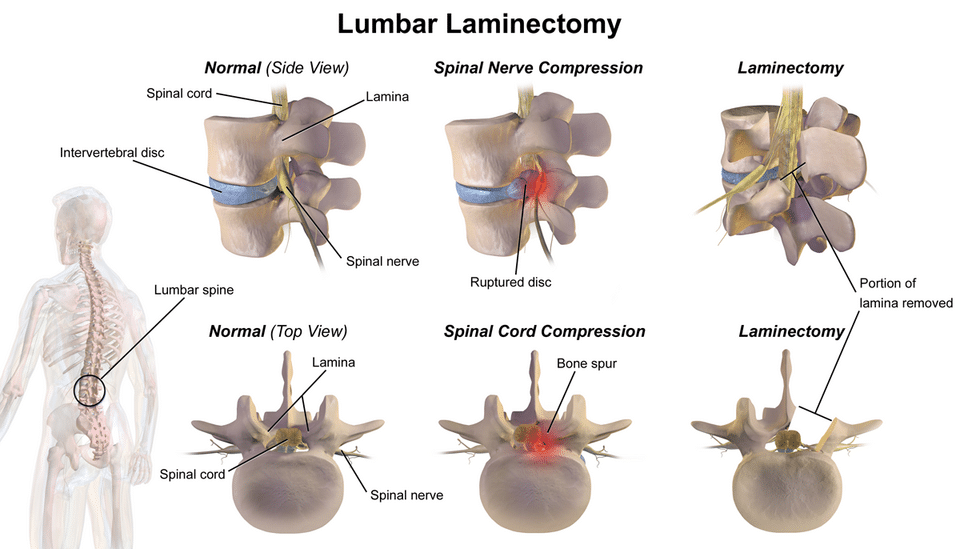
This animation from Spine-health shows how the procedure is performed:
Video: Lumbar Laminectomy Surgery Video, courtesy of Spine-health.com
Benefits and Risks
Benefits
- Relief of leg pain, numbness and heaviness for most patients
- The ability to stand longer and walk farther
- Better strength in the legs when nerve compression is relieved before damage is permanent
- No implants needed when the spine is stable
Risks
- A small tear in the lining around the nerves (a spinal fluid leak), which is usually repaired during surgery
- Infection or bleeding
- Nerve injury, which is rare
- Instability of the spine later on, which can require a fusion
- Stenosis returning at the same or a different level over time
- Risks related to anesthesia, including blood clots
Why Choose Dr. Betsy Grunch for Your Lumbar Laminectomy
- Duke-trained: Dr. Grunch completed her neurosurgical residency and a spine research fellowship at Duke University School of Medicine, one of the top neurosurgery programs in the country, where she received the Spine Young Investigator Award.
- Minimally invasive by design: Minimally invasive spine surgery is one of her signature areas. She works through the smallest opening that will safely do the job, so you can get back on your feet sooner.
- Experience you can count on: She has been in practice since 2013 and performs 400 to 600 surgeries a year, more than 5,000 procedures over her career.
- The right operation for your spine: She carefully checks for instability so you get a decompression when that is enough, and a fusion only when you truly need one.
- Second opinions and revisions: She regularly sees patients who had spine surgery elsewhere and want a second opinion or need a revision.
- A teacher at heart: As “Ladyspinedoc,” she is known for explaining spine conditions clearly. You’ll leave your visit understanding your imaging and every option in front of you.
What to Expect
Before surgery
You’ll meet with Dr. Grunch or one of her physician assistants to review your imaging, your exam and your goals, and to decide together whether a lumbar laminectomy is right for you. Our team will coordinate any pre-operative testing, review your medications (including blood thinners you may need to pause) and walk you through the day of surgery so nothing is a surprise. If you smoke or use nicotine, stopping before surgery lowers the risk of complications.
Procedure day
The surgery usually takes one to two hours, depending on the number of levels. Many patients go home the same day, and some stay one night in the hospital. You’ll be up and walking the day of surgery.
Recovery timeline
- First days: Leg pain and heaviness often improve quickly. Some soreness at the incision is normal.
- First two weeks: Walk every day and gradually increase your distance. Your first follow-up visit is about two weeks after surgery.
- Two to six weeks: Many people return to desk work. Dr. Grunch may start physical therapy to build strength and endurance.
- Six weeks and beyond: Most patients return to normal activities. Numbness and strength can keep improving for several months.
Every patient heals differently. Your exact timeline will depend on your symptoms, your job and your overall health.
Watch Dr. Grunch’s post-op care instructions:

Video: Post-op Care for Minimally Invasive Lumbar Laminectomy, from Dr. Grunch on her Ladyspinedoc channel (YouTube)
Caring for yourself at home
- Walking: Walk 30 to 60 minutes a day, broken into 10- to 15-minute sessions, and try not to sit for more than 30 minutes at a time.
- Restrictions for about six weeks: No bending at the waist, no twisting and no lifting more than 10 pounds. That includes household chores, yard work, golf and lifting young children or grandchildren.
- Your incision: You may shower the day after surgery without scrubbing the incision. Don’t use ointments or creams, and don’t soak in a bath, hot tub or pool for six weeks. Ice the incision twice a day for 20 minutes during the first week.
- Medications: Take pain medication with food and avoid alcohol while taking it. A daily stool softener helps prevent constipation. Blood thinners are held after surgery until Dr. Grunch’s team tells you to restart them.
- Driving: You may drive once you are no longer taking narcotic pain medication.
- Follow-up: Your first follow-up visit is about two weeks after surgery.
Watch Dr. Grunch’s tips for recovering from spine surgery:
Video: 6 Tips for Your Recovery From Spine Surgery, from Dr. Grunch on her Ladyspinedoc channel (YouTube)
Call the office at 470-293-9800 if you have a fever over 101°F, redness, warmth or significant drainage from the incision, calf pain or swelling, constipation that medication doesn’t relieve, new trouble controlling your bladder or bowels, or back or leg pain that is worse than before surgery. Call 911 for chest pain or shortness of breath.
Download your patient instructions
Print these sheets or save them to your phone so you have them before and after surgery:
- Preparing for surgery: Lumbar Laminectomy (PDF)
- Post-operative guidelines: Minimally Invasive Lumbar Surgery (PDF)
You’ll find instructions for other procedures on our Patient Resources page.
Frequently Asked Questions
Is a laminectomy the same as a fusion?
No. A laminectomy removes bone and tissue to take pressure off the nerves. A fusion joins vertebrae together with implants and bone graft to stop motion. Many patients need only a laminectomy. A fusion is added only if the spine is unstable or slipping.
Will my back be weaker without the lamina?
For most people, no. The strong facet joints, discs and muscles continue to support the spine. Dr. Grunch preserves the facet joints as much as possible to protect stability.
How soon will I be able to walk farther?
Many patients notice they can stand and walk longer within the first few weeks. Endurance keeps improving as you rebuild strength after months or years of limited walking.
Will my stenosis come back?
The levels that were treated usually stay open for many years. Because stenosis is part of aging, it can develop at other levels over time.
I’m older. Am I too old for this surgery?
Age alone isn’t a reason to avoid a laminectomy. Many patients in their 70s and 80s do very well and regain the ability to walk and stay independent. Dr. Grunch will review your overall health with you.
Take the First Step Toward Relief
Living with stenosis can shrink your world one shorter walk at a time. Whether you need a treatment plan, a second opinion or a clear explanation of your imaging, Dr. Grunch and the Southern Neurosurgery team are here to help.
Call 470-293-9800 to schedule an appointment or contact us online.
Have a question first? Ask our virtual assistant anything, 24/7.
We see patients across metro Atlanta and North Georgia at our offices in Gainesville, Sandy Springs and South Atlanta (Riverdale). Find the office nearest you.
Related pages: Spinal stenosis · Foraminal stenosis · Spondylolisthesis · Laminotomy · Foraminotomy · Lumbar fusion
This page is for educational purposes only and is not medical advice. It does not replace individualized care from a licensed physician. Please talk with your own doctor about your symptoms. If you have bladder or bowel changes, groin numbness or rapidly worsening weakness, call 911 or go to the nearest emergency room.