
Schwannomas: Treating Benign Nerve Sheath Tumors
A schwannoma is a slow-growing, almost always benign tumor of a nerve’s outer covering. Many can be watched safely, and those that cause symptoms can often be removed completely.
What Is a Schwannoma?
A schwannoma grows from Schwann cells, which form the insulating sheath around nerves. Because it grows off to one side of the nerve rather than through it, a schwannoma can often be separated from the nerve and removed. Schwannomas can develop on spinal nerve roots, on nerves in the arms and legs, or on the hearing and balance nerve (vestibular schwannoma or acoustic neuroma).
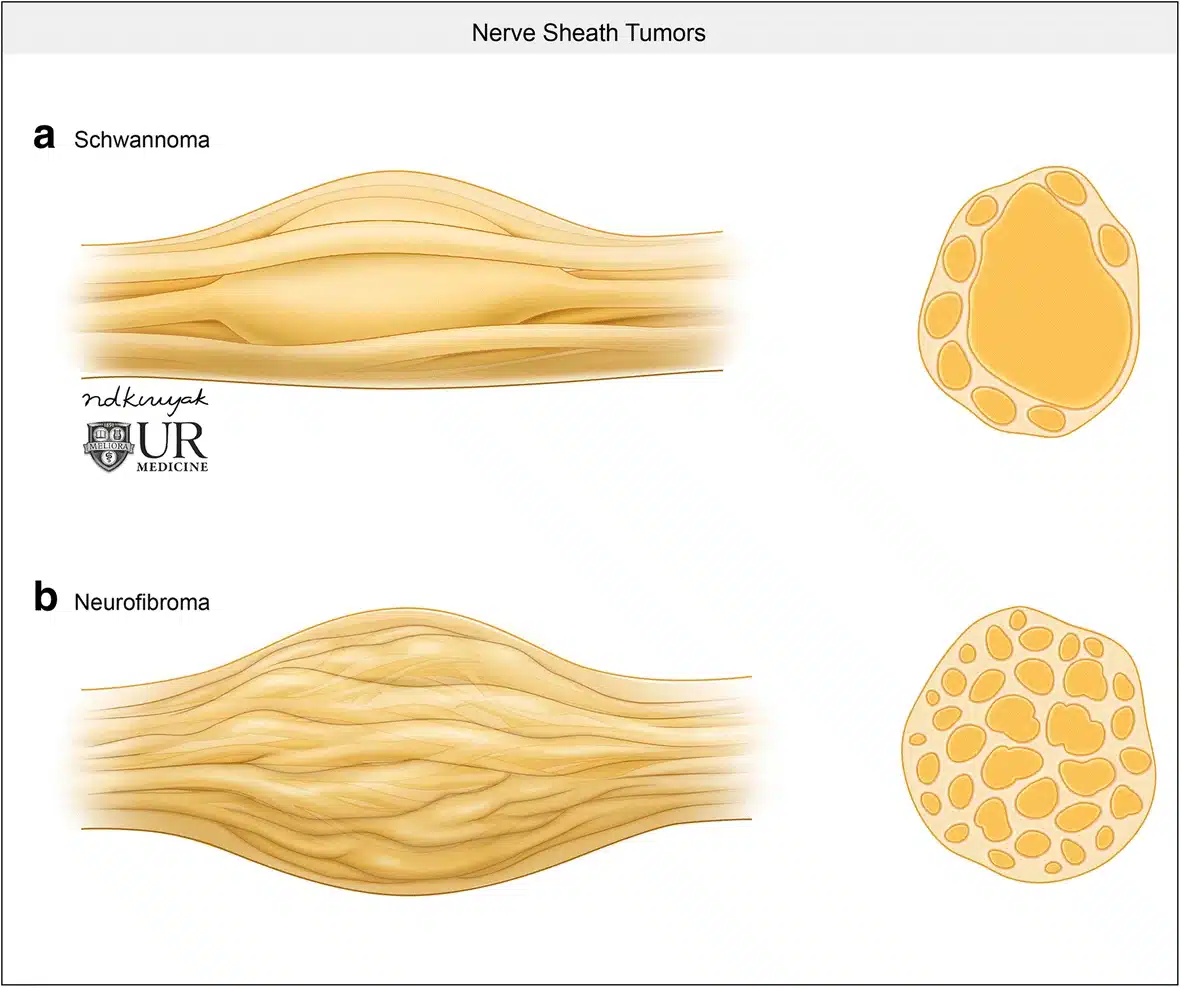
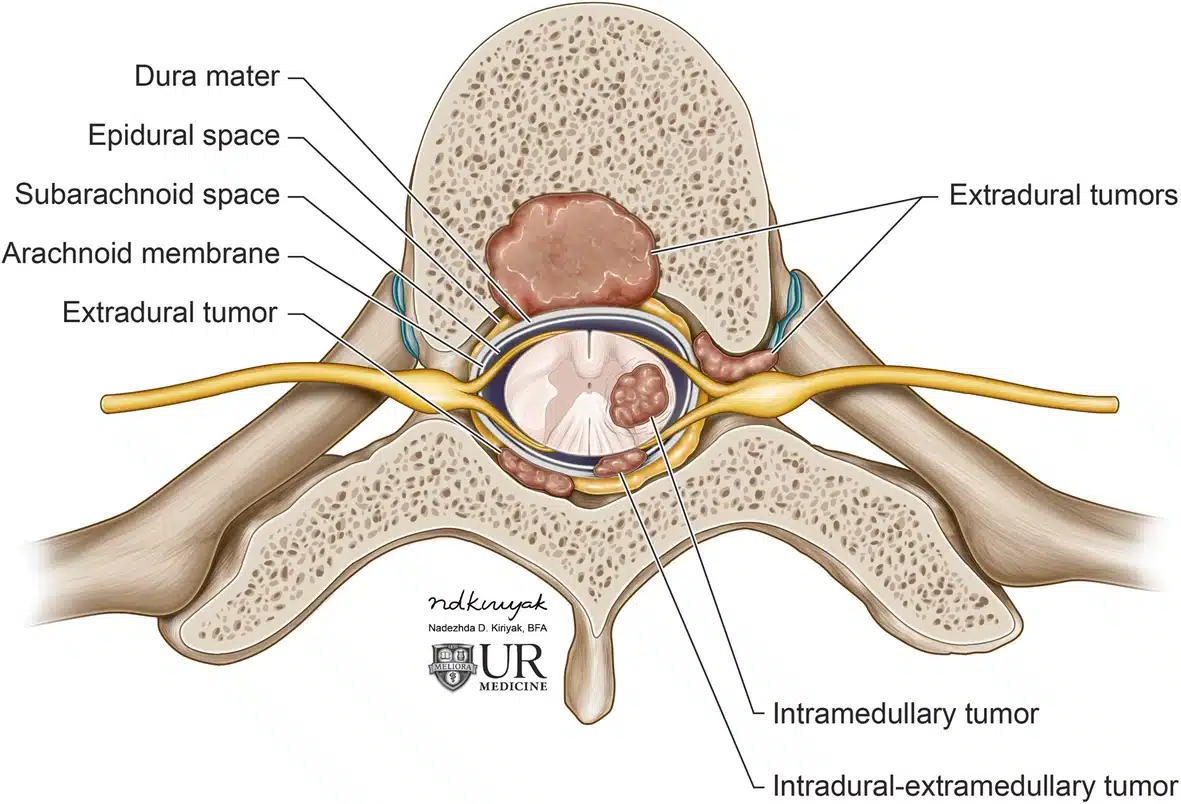
In the spine, schwannomas are one of the most common tumors inside the spinal canal. Some grow out through the opening where the nerve leaves the spine, creating a “dumbbell” shape partly inside and partly outside the canal.
Symptoms
Common symptoms
- Pain that travels along one nerve, into an arm, leg or around the chest
- Back or neck pain, often worse at night
- Numbness or tingling
- Weakness in the muscles supplied by that nerve
Symptoms patients often ignore
- Nerve pain that doesn’t respond to typical treatment for a pinched nerve
- A painless lump along an arm or leg that causes tingling when tapped
- Slowly worsening balance or leg stiffness from spinal cord pressure
When it’s an emergency: Rapidly worsening weakness, numbness in the groin, or bladder or bowel changes need emergency care. Call 911 or go to the nearest emergency room.
Causes and Risk Factors
Most schwannomas occur on their own with no known cause. Multiple schwannomas can be a sign of a genetic condition, such as neurofibromatosis type 2 (NF2) or schwannomatosis.
How We Diagnose Schwannomas
- Neurological exam: strength, sensation and reflexes along the affected nerve
- MRI with contrast: shows the tumor, the nerve it arises from and any pressure on the spinal cord
- CT scan: shows widening of the bony opening where a dumbbell tumor passes through
- EMG/nerve studies: sometimes used for tumors on nerves in the arms or legs
- Genetic evaluation: considered when there is more than one tumor
Treatment Options
Observation
Small schwannomas that aren’t causing symptoms can usually be monitored with periodic MRI scans.
When surgery makes sense
Surgery is recommended for schwannomas that cause pain, numbness, weakness or spinal cord pressure, or that are growing. Because the tumor grows beside the nerve, surgery can often remove it completely and correct the problem. Using a microscope and nerve monitoring, the surgeon separates the tumor from the healthy nerve fibers (spinal cord tumor resection). Dumbbell tumors may need a combined approach and, occasionally, spinal stabilization.
Radiation
Focused stereotactic radiation may be an option for tumors that can’t be completely removed, return, or are in patients who aren’t surgical candidates.
Why Choose Dr. Betsy Grunch for Schwannomas
- Duke-trained: neurosurgical residency and spine research fellowship at Duke University School of Medicine, where she received the Spine Young Investigator Award
- Experience you can count on: in practice since 2013, performing 400 to 600 surgeries a year and more than 5,000 procedures over her career
- Precise, protective surgery: microsurgical technique with nerve monitoring to protect nerve function
- The right treatment for you: board-certified (FAANS, FACS, FCNS), she starts with the least invasive option that will work, and recommends surgery when it can correct the problem
- Clear answers: known online as Ladyspinedoc, she makes sure you understand your imaging and every option in front of you
What to Expect If You Need Surgery
Before surgery
You’ll meet with Dr. Grunch or one of her physician assistants to review your MRI and plan the procedure. Our team coordinates pre-operative testing and reviews your medications.
Procedure day
Surgery for a spinal schwannoma typically takes a few hours, and most patients stay in the hospital for one to a few days.
Recovery timeline
- Days 1-3: walking right away
- Weeks 1-6: gradual return to normal activity; avoid heavy lifting and bending
- Weeks 6-12: return to exercise and most activities as cleared
- Months: nerve pain often improves quickly; numbness and strength can keep improving
Frequently Asked Questions
Is a schwannoma cancer?
Almost always no. Schwannomas are benign tumors. Malignant nerve sheath tumors are rare.
What’s the difference between a schwannoma and a neurofibroma?
A schwannoma grows off to one side of the nerve, so it can often be removed without cutting the nerve. A neurofibroma grows within the nerve fibers.
Will I lose function in the nerve?
In most cases, the nerve is preserved. Some patients have a small area of numbness afterward, which often improves or is not bothersome.
Can it come back?
Recurrence after complete removal is uncommon.
Does it need to come out if it isn’t causing symptoms?
Not necessarily. Many small schwannomas are safely watched with MRI scans.
Take the Next Step
Hearing that you have a tumor is frightening. Whether you need a diagnosis, a treatment plan or a second opinion, Dr. Grunch and the Southern Neurosurgery team are here to help you understand your options.
Call 470-293-9800 to schedule an appointment or contact us online.
Have a question first? Ask our virtual assistant anything, 24/7.
We see patients across metro Atlanta and North Georgia at our offices in Gainesville, Sandy Springs and South Atlanta (Riverdale). Find the office nearest you.
This page is for educational purposes only and is not a substitute for medical advice. If you have sudden weakness, numbness in the groin, or bladder or bowel changes, call 911 or go to the nearest emergency room.