
Peripheral Nerve Tumors: Answers for a Lump Along a Nerve
A lump under the skin that tingles or sends a shock down your arm or leg when you touch it may be a nerve tumor. Most nerve tumors are benign, and many can be removed while protecting the nerve.
What Are Nerve Tumors?
Nerve tumors grow from the cells that make up or surround a nerve. They can develop on the spinal nerve roots or on peripheral nerves anywhere in the body, such as in the neck, arm, wrist, pelvis, thigh or leg. The most common are nerve sheath tumors, which start in the protective covering of the nerve.
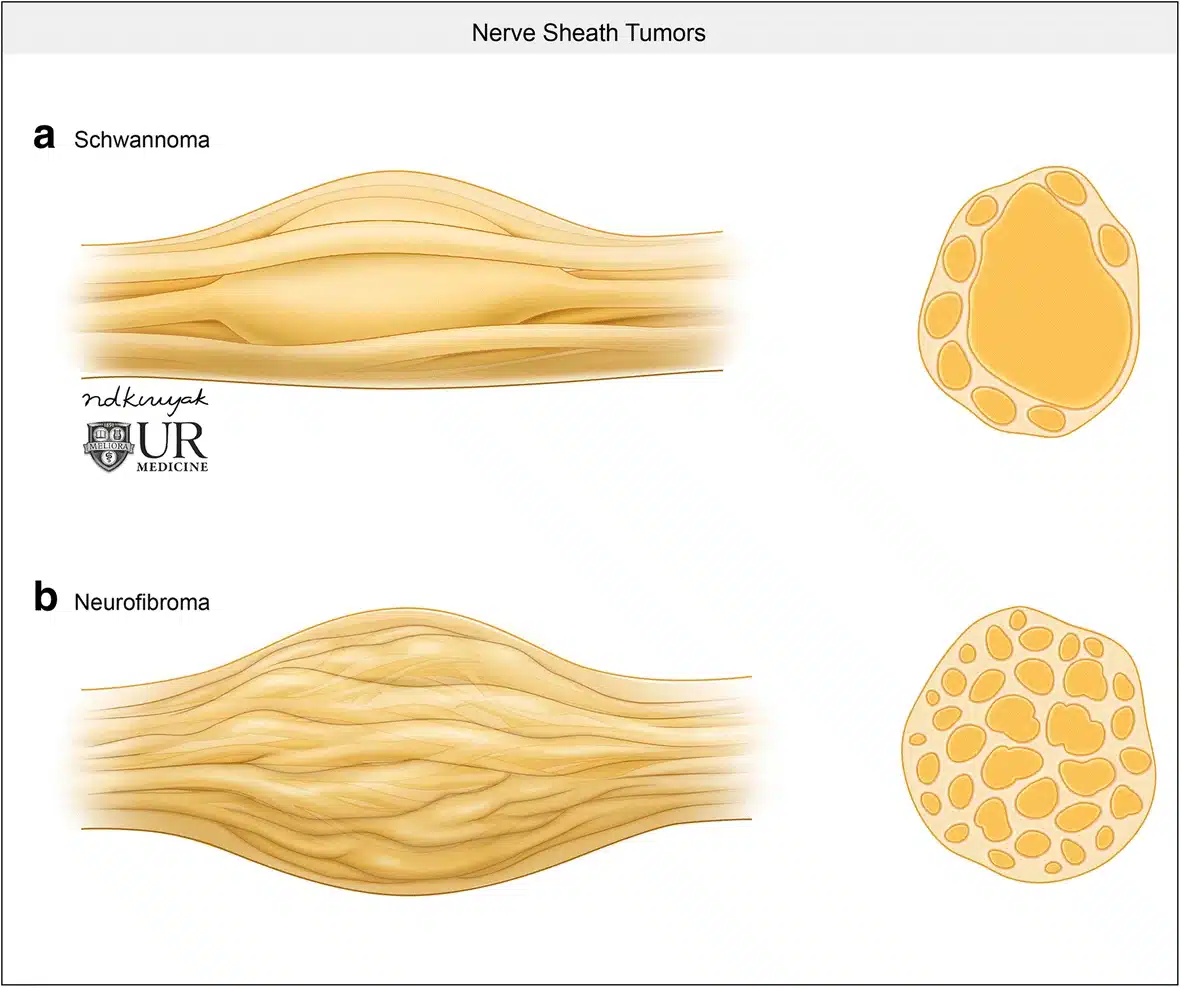
Types of Nerve Tumors
- Schwannomas: the most common; grow off to one side of the nerve and can usually be separated from it
- Neurofibromas: grow within the nerve fibers; can occur alone or with neurofibromatosis type 1 (NF1)
- Perineuriomas and other benign tumors
- Non-nerve masses near nerves: such as ganglion cysts, lipomas and intraneural ganglion cysts
- Malignant peripheral nerve sheath tumors (MPNST): rare cancers, more common in people with NF1
Symptoms
Common symptoms
- A lump or mass along an arm, leg or the neck
- Tingling or an electric shock feeling when the lump is tapped or pressed
- Pain, numbness or tingling along the nerve’s path
- Weakness in the muscles the nerve controls
Symptoms patients often ignore
- A slowly growing lump that doesn’t hurt
- Numbness or weakness that gets blamed on carpal tunnel or a pinched nerve
- Night pain in an arm or leg
See a doctor promptly if a lump is growing quickly, becomes painful, feels hard and fixed, or comes with new weakness. These can be signs of a more serious tumor, especially in people with NF1.
Causes and Risk Factors
Most nerve tumors have no known cause. Genetic conditions that raise the risk include neurofibromatosis type 1 (NF1), neurofibromatosis type 2 (NF2) and schwannomatosis. Prior radiation is a rare risk factor.
How We Diagnose Nerve Tumors
- History and exam: how long the lump has been there, how it has changed and how the nerve is working
- MRI with contrast: shows the tumor’s size, its relationship to the nerve and features that suggest a benign or malignant tumor
- Ultrasound: can help confirm a mass is connected to a nerve
- EMG/nerve conduction studies: measure how well the nerve is working
- PET scan or biopsy: when a malignant tumor is a concern
Treatment Options
Observation
Small, stable nerve tumors that aren’t causing symptoms can often be watched with periodic exams and imaging.
When surgery makes sense
Surgery is recommended for tumors that cause pain, numbness or weakness, that are growing, or when the diagnosis is uncertain. Using magnification and nerve monitoring, the surgeon separates the tumor from the healthy nerve fibers. Schwannomas can often be removed completely while the nerve is preserved, which can often correct the problem. Neurofibromas within the nerve may require partial removal to protect function.
Malignant tumors
Malignant nerve sheath tumors are treated by a team that may include surgery to remove the tumor with a margin of healthy tissue, radiation and chemotherapy.
Why Choose Dr. Betsy Grunch for Nerve Tumors
- Duke-trained: neurosurgical residency and spine research fellowship at Duke University School of Medicine, where she received the Spine Young Investigator Award
- Experience you can count on: in practice since 2013, performing 400 to 600 surgeries a year and more than 5,000 procedures over her career
- Brain, spine and peripheral nerve expertise: as a neurosurgeon, she treats nerve conditions from the spinal cord to the limbs
- The right treatment for you: board-certified (FAANS, FACS, FCNS), she starts with the least invasive option that will work, and recommends surgery when it can correct the problem
- Clear answers: known online as Ladyspinedoc, she makes sure you understand your imaging and every option in front of you
What to Expect If You Need Surgery
Before surgery
You’ll meet with Dr. Grunch or one of her physician assistants to review your imaging and nerve testing and plan the procedure. Our team coordinates any pre-operative testing.
Procedure day
Many peripheral nerve tumor surgeries are outpatient, and you go home the same day. Tumors on spinal nerve roots may require a short hospital stay.
Recovery timeline
- Weeks 1-2: incision healing; light use of the arm or leg
- Weeks 2-6: gradual return to normal activities and work
- Months: numbness and strength can continue to improve as the nerve recovers
Frequently Asked Questions
Are nerve tumors cancer?
The vast majority are benign. Malignant nerve sheath tumors are rare.
Will removing the tumor damage my nerve?
Most schwannomas can be removed while preserving the nerve. Some patients have a small area of numbness afterward. Your surgeon will discuss your specific risks.
Does every nerve tumor need to be removed?
No. Small tumors without symptoms can often be watched.
Why does tapping the lump cause tingling?
Pressing on a tumor attached to a nerve irritates the nerve, sending a tingling or shock feeling along its path. This is a helpful clue that the lump involves a nerve.
Can a nerve tumor come back?
Recurrence after complete removal of a benign tumor is uncommon.
Take the Next Step
Hearing that you have a nerve tumor is frightening. Whether you need a diagnosis, a treatment plan or a second opinion, Dr. Grunch and the Southern Neurosurgery team are here to help you understand your options.
Call 470-293-9800 to schedule an appointment or contact us online.
Have a question first? Ask our virtual assistant anything, 24/7.
We see patients across metro Atlanta and North Georgia at our offices in Gainesville, Sandy Springs and South Atlanta (Riverdale). Find the office nearest you.
This page is for educational purposes only and is not a substitute for medical advice. If you notice a rapidly growing or painful lump or new weakness, see a doctor promptly.